
English
Did you know a standalone zoom camera cannot move itself?
It requires a mechanical platform to achieve full area coverage. Integrating these distinct parts solves complex video surveillance and broadcasting challenges. In this comprehensive guide, we will walk through the exact technical steps required to seamlessly integrate a zoom module into a pan-tilt-zoom housing. By understanding the core mechanics, you can eliminate guesswork and build a highly responsive, industrial-grade surveillance system.
Integrating an imaging module into a mechanical platform requires aligning three core components. These are physical hardware, communication protocols, and video output interfaces.
Standard control protocols are absolutely essential. They translate raw joystick inputs or software commands into smooth, precise mechanical movements.
Choosing the correct imaging payload dictates the internal design of the housing. This choice affects everything from weight distribution to thermal management.
Modern integrations rely heavily on IP connectivity. Network-ready modules have become the industry standard for cloud-based management, ultra-low latency transmission, and remote software control.
The surveillance industry is rapidly shifting toward edge-based AI processing and ultra-long-range optical intelligence. Modern integrations are no longer just about basic mechanical movement. Engineering teams now focus on embedding neural processing directly at the camera node. This evolution drastically reduces server bandwidth and allows for autonomous target tracking in harsh environments. Furthermore, the transition from analog to fully IP-based architectures means that selecting a network-ready imaging payload has become the absolute baseline for future-proofing any large-scale deployment. The market demands systems that can identify targets miles away while seamlessly integrating into cloud-based management platforms.
To successfully build or upgrade a surveillance or live-streaming system, engineers must first clearly define the functional boundary between the imaging module and its mechanical enclosure.
The camera module serves as the eye and brain of the entire setup. It consists of a high-sensitivity CMOS image sensor, a motorized lens assembly, and a dedicated Image Signal Processor. This processor handles critical real-time functions such as auto-focus, white balance, wide dynamic range, and digital noise reduction. However, a standalone block camera lacks the external motors required to pan left and right or tilt up and down. Its internal micro-motors are strictly dedicated to shifting glass elements to adjust focal length and focus.
In contrast, the platform acts as the mechanical neck and body. This robust enclosure contains heavy-duty stepper motors, drive belts, and a main motherboard. Its sole responsibility is to physically manipulate the camera payload. Industrial-grade platforms also incorporate environmental safeguards. You will frequently see weatherproof seals, internal heaters to prevent lens fogging, and automated wiper systems tailored for harsh outdoor deployments.
The primary advantage of separating the optical payload from the mechanical housing is pure modularity. Integrators can select a highly specialized enclosure, such as an explosion-proof stainless steel rig for chemical plants, and pair it with a specific camera block tailored to the required optical performance. Consequently, this modular approach allows for targeted hardware upgrades over time without forcing the replacement of expensive mechanical infrastructure.
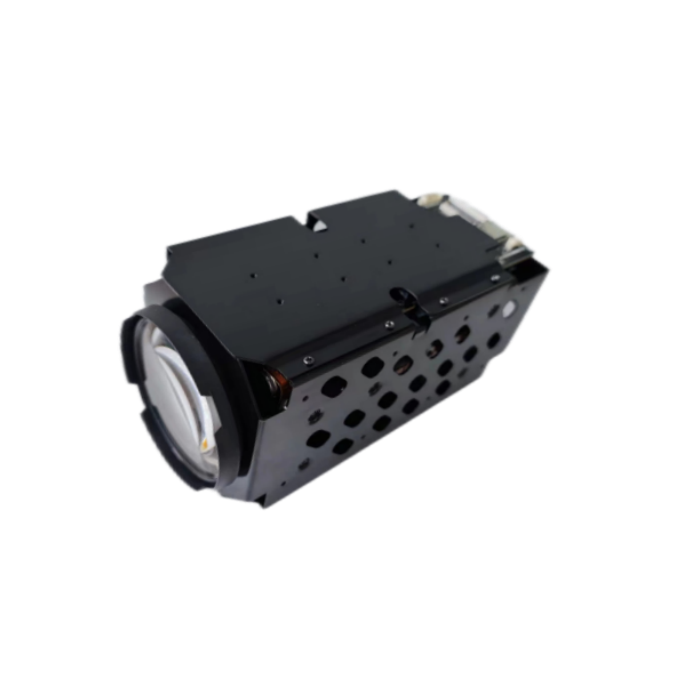
Physical integration goes far beyond tightening a few screws. It demands precise mechanical alignment and highly secure electronic connections to guarantee signal integrity during continuous, rapid movement.
Mounting the camera block inside the dome requires meticulous attention to the center of gravity. A payload mounted even slightly off-center places uneven, continuous torque on the stepper motors. Over time, this guarantees premature mechanical failure and jittery video output. In practice, seasoned engineers utilize custom-machined mounting brackets and vibration-dampening standoffs to lock the module securely in place. Applying thermal paste or utilizing conductive thermal pads is also a standard operating procedure. This draws heat away from the processor and dissipates it through the sealed outer chassis, preventing thermal throttling during peak operation.
Visual data must be efficiently routed from the imaging module to the baseboard. The interface you choose depends heavily on the payload output capabilities and the encoding board sitting in the platform.
LVDS: The undisputed industry standard for internal connections. It transmits high-speed, uncompressed digital video over incredibly short distances with minimal electromagnetic interference.
HDMI: Frequently utilized in broadcast-grade setups for uncompressed 4K delivery via standard consumer cables.
SDI: The go-to for professional audio-visual environments, requiring precise coaxial routing to maintain a locked signal.
CVBS: Found mostly in legacy analog systems, utilizing a simple two-wire connection for standard-definition feeds.
One of the most complex mechanical challenges is routing power and data without tangling internal wires during continuous 360-degree panning. The solution is the slip ring. This sophisticated electromechanical component allows power and electrical signals to bridge a stationary base and a rotating structure. The slip ring provides a steady direct current to the module while simultaneously passing the video data and serial control pulses down to the stationary motherboard.
Physical connections alone will not bring the system to life. The main control board and the optical module must speak the same language using standardized serial protocols.
Inside the housing, the physical layer for communication is typically RS-485. Industrial integrators prefer this standard because it leverages differential signaling, making it highly immune to the electrical noise inevitably generated by the surrounding stepper motors. The motherboard acts as the master controller, firing precise hexadecimal data packets over the serial line to the receive and transmit pins of the imaging block.
When a security operator pushes a joystick forward, the control board instantly processes that analog input. It translates the tilt command into electrical pulses that drive the motors. Concurrently, if the operator twists the joystick knob to zoom in, the board fires a distinct protocol command straight to the lens module. The two dominant languages for this are VISCA and Pelco-D. VISCA is the gold standard for high-precision optical gear. It supports absolute positioning, meaning the software can instruct the lens to hit a highly specific focal length at a defined speed. Ensuring the baud rate and protocol settings perfectly match via physical DIP switches is a non-negotiable step before sealing the enclosure.
The landscape of video surveillance and broadcasting has fundamentally shifted toward IP-based workflows. Converting a raw imaging block into a fully functional Network Zoom Camera requires additional hardware integration within the base.
To achieve network readiness, technicians install an IP encoding board inside the base. This board captures the raw LVDS signal and compresses it using highly efficient codecs. The encoded stream is then packetized and pushed out via a standard network port. Consequently, the live feed becomes globally accessible via IP routing, entirely bypassing the limitations of localized coaxial cable runs.
Integrating Power over Ethernet compliance onto the baseboard allows a single cable to carry data, control, and power. An internal splitter steps down the network current to the voltage required by the motors and the lens. This brilliant design completely eliminates the need for dedicated electrical outlets at the mounting site, saving thousands of dollars in installation costs.
The ultimate success of your integration project hinges almost entirely on selecting the correct optical payload before a single screw is turned. The enclosure provides the muscle, but the internal block dictates the visual fidelity and commercial value.
To ensure maximum operational efficiency, engineers must match the module specifications directly to the deployment environment. Below is a practical selection matrix based on real-world engineering standards.
Application Scenario | Recommended Specifications | Key Technology Required |
|---|---|---|
Border & Coastal Security | 80X to 96X Optical Magnification, 3MP or 4MP Resolution | Super Starlight Sensor, Optical Defog, Laser Synchronization |
Highway & Traffic Monitoring | 36X to 40X Magnification, 3MP Resolution | Global Shutter, High-speed Capture, Anti-jello Effect |
Urban City Surveillance | 30X to 40X Magnification, 4K Ultra HD | Wide Dynamic Range, Rapid Auto-focus Tracking |
Securing national borders or critical infrastructure requires identifying human targets at extreme distances. In these high-stakes scenarios, engineers rely heavily on a Long Range Zoom Camera module. Payloads boasting 80X or even 96X magnification are bolted into ruggedized, wind-resistant housings. For instance, a 96X 3MP Global Shutter module combined with Super Starlight technology allows operators to read a license plate miles away in near-total darkness without motion blur.
It is critical to separate true mechanical magnification from digital cropping. A professional Optical Zoom Camera physically shifts internal glass elements to enlarge the subject before light ever strikes the sensor. This ensures absolutely zero loss in resolution. Digital magnification merely stretches existing pixels, instantly degrading the image quality. Your required ratio depends on the environment. A 30x module is the sweet spot for urban traffic intersections, while 80x and above is strictly reserved for maritime or military observation.
The electronic shutter mechanism heavily impacts video clarity during rapid movement. Standard rolling shutters scan the sensor line by line. When the platform pans quickly, this creates a jello effect, skewing vertical lines like street poles. For high-speed tracking applications, integrators must specify a Global Shutter. This technology exposes every pixel simultaneously, guaranteeing that fast-moving objects remain frozen and distortion-free.
Even with flawless mechanical alignment, marrying disparate electronic systems inevitably presents technical hurdles during the initial testing phase. Knowing how to diagnose these issues separates novice installers from master integrators.
A frequent complaint is a sluggish delay between pushing the joystick and seeing the lens react. This is rarely a mechanical defect. It usually points to a network bottleneck or a serial configuration error. Technicians troubleshoot this by verifying that the baud rates match perfectly across all devices and by running diagnostics to check for packet loss in the control stream.
Auto-focus hunting happens when the lens frantically pulses in and out of focus during a sweeping movement. Because most processors rely on contrast detection, rapid scene changes easily confuse the algorithm. The practical fix involves tweaking the firmware to temporarily lock the focal plane the moment the motors engage. The system only allows the autofocus to re-engage once the camera has come to a complete stop.
If the housing pans successfully but the lens refuses to magnify, you are likely facing a protocol mismatch. This happens when the motherboard broadcasts one language, but the optical block is listening for another. Resolving this requires opening the chassis to flip the physical DIP switches on the module, or logging into the web interface to align the logical settings.
Integrating an imaging module into a mechanical platform requires meticulous planning and technical precision. You must perfectly align the physical mounting hardware, synchronize the serial communication protocols, and configure the network encoding. The synergy between the intelligent optical block and the rugged mechanical base is what ultimately defines the success of your entire surveillance system. By applying these engineering principles and selecting the correct payload for your specific environment, you can build highly reliable, professional-grade video solutions.
Ready to upgrade your surveillance infrastructure with industrial-grade optical precision? Explore the high-performance block modules at FutureVision CCTV to find the exact hardware specifications required for your next demanding integration project.
A zoom camera, often called a block camera, is an independent imaging device containing the sensor, processor, and motorized lens assembly required to achieve focus and magnification. However, it cannot alter its physical orientation. A pan-tilt-zoom camera is the finalized, integrated system. It consists of an outer mechanical housing equipped with motors, driver boards, and slip rings, with the imaging module securely mounted inside to provide horizontal and vertical movement.
Yes, upgrading the internal payload is an excellent way to extend the life of high-end enclosures, but it requires strict compatibility checks. The physical dimensions and center of gravity of the new module must fit without obstructing the tilt axis. Furthermore, the video output interface and the communication protocol must perfectly match the existing control board to ensure seamless operation.
Legacy analog integrations require a messy web of disparate cables for video, serial control, and power. A network-ready module incorporates an onboard IP encoder. This brilliant design allows high-definition video, bidirectional control commands, and power to travel through a single standard Ethernet cable. This drastically reduces wiring complexity inside the slip ring, minimizes mechanical wear, and enables remote cloud management.
For extreme long-range observation, the VISCA protocol is overwhelmingly preferred. It was engineered for complex optical control and offers unparalleled precision. When tracking a target three miles away using an 80x lens, the slightest motor adjustment matters. This protocol supports variable micro-speed control and query commands, allowing the operator to adjust the frame smoothly without overshooting the target.
Not necessarily. The required software depends on your integration method. If you utilized an IP-based module, the system will likely support standard open network video interfaces, allowing it to be controlled by almost any third-party video management software or a standard web browser. If the integration was designed for audio-visual use and supports USB video class protocols, you can control the mechanical movements natively through standard enterprise video conferencing platforms.
Engineers solve this by utilizing an internal power distribution board or a Power over Ethernet splitter. The main power line enters the base of the housing and routes through the slip ring. The distribution board then steps down the voltage, sending appropriate currents to the heavy-duty stepper motors while supplying a clean, regulated direct current to the sensitive optical module.
Video jitter at high magnification is almost always a mechanical or environmental issue, not an optical defect. When a lens is zoomed in at 80X or 96X, even a microscopic vibration in the housing is magnified exponentially on screen. This is typically caused by inadequate vibration-dampening standoffs during installation, an off-center payload throwing off the motor balance, or heavy winds hitting a housing that lacks proper aerodynamic stabilization.


