
English
Bought a high-end thermal device but find yourself squinting at a blurry, distant blob on the monitor? This is a common frustration on the front lines of security integration. The lens focal length dictates exactly what your sensor can detect, recognize, and identify. Let's decode these optical specifications. You need your hardware to perfectly match your operational reality, avoiding costly blind spots.
Focal Length Dictates Perspective: Shorter lenses provide a wider Field of View for close-up monitoring. Longer lenses narrow the visual cone to pierce through darkness over vast distances.
DRI is the Ultimate Metric: Your optical choice depends entirely on the Detection, Recognition, and Identification parameters required by your specific deployment environment.
Resolution Must Match the Lens: High-resolution cores paired with the appropriate lens maximize image clarity. This prevents the target from turning into an unrecognizable blur at maximum zoom.
Application Drives the Hardware: Sweeping indoor inspections demand vastly different optical setups than border security outposts or maritime navigation vessels.
To select the correct equipment for your security or industrial application, we must first demystify the mechanics of optical lenses. In practical terms, focal length is the physical distance between the camera's microbolometer and the optical center of the lens when focused at infinity. We measure this in millimeters, such as 9mm, 25mm, or 150mm. This precise measurement determines the magnification power of the camera and the physical area it can capture in a single frame.
Unlike standard visible-light cameras that rely on traditional optical glass, thermal lenses are manufactured from highly specialized materials. Standard glass completely blocks infrared heat signatures. This renders a thermal sensor blind. Therefore, manufacturers utilize Germanium. This metalloid is highly transparent to infrared radiation, allowing the sensor to process accurate temperature data. Consequently, Germanium is a rare and expensive material. The physical size and focal length of the optical assembly directly dictate the overall cost of the system.
When evaluating these systems, operators must remember the golden rule of optics. There is a strict inverse relationship between focal length and field of view. Opting for a lower millimeter count yields a wider perspective but sacrifices monitoring range. Conversely, selecting a higher millimeter count severely narrows your field of view but exponentially increases your effective detection distance.
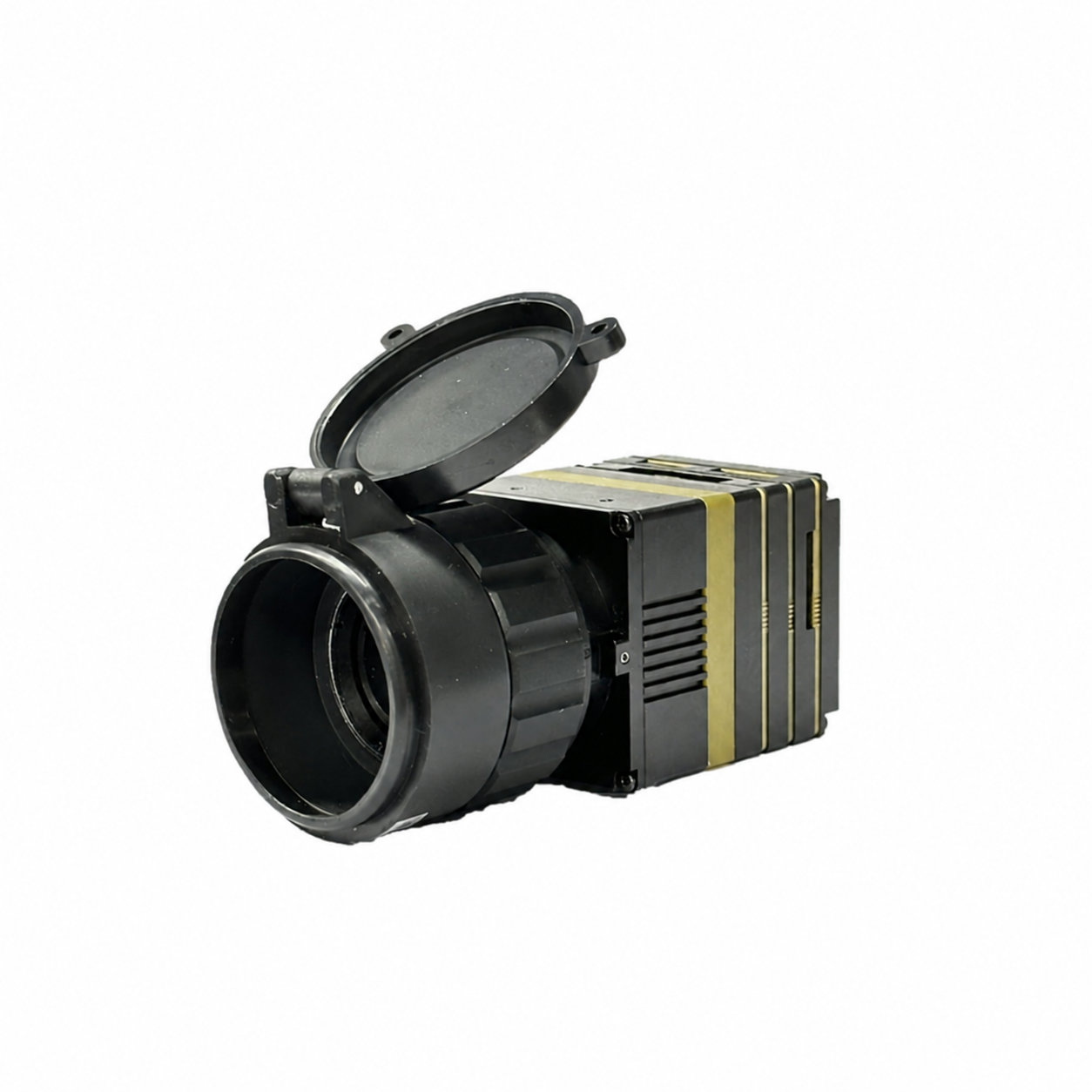
The primary function of any lens is to dictate how wide and how far your camera can see. These two critical performance metrics are defined by FOV and the DRI standard.
Field of View refers to the observable area the camera can capture at any given moment, measured in degrees. A wide FOV is absolutely crucial for maximum situational awareness. Imagine a vast, dimly lit warehouse floor. A wide-angle lens allows a single sensor to sweep the entire loading dock without needing to physically pan the camera. However, this broad perspective spreads the sensor's available pixels over a massive area. This significantly reduces the number of pixels covering distant objects.
In the thermal surveillance industry, performance is scientifically measured using the DRI standard. This is based on Johnson's Criteria. This established metric dictates how many pixels are required across a target's critical dimension to achieve a specific level of observation.
Detection: Acknowledging that an anomaly is present. The target appears simply as a warm pixel or blob, distinct from the cooler background.
Recognition: Determining the class of the object. The operator can distinguish whether the warm blob is a human, a grazing animal, or a vehicle.
Identification: Discerning specific, actionable details. Security personnel can determine if the recognized human is holding a tool, or distinguish the specific model of an approaching truck.
Specifically, by increasing the focal length, the lens physically magnifies the infrared image. This concentrates more pixels onto a distant target. This optical concentration is exactly what pushes your DRI ranges further out into the field.
To make things actionable, let's break down how different focal lengths perform in real-world scenarios. We can categorize these into three main operational zones based on engineering standards.
Lens Category | Focal Length | Typical FOV | Primary Application | Target DRI Range |
|---|---|---|---|---|
Wide-Angle | Under 15mm | 45° to 90°+ | Indoor monitoring, drone roof inspections | Close-range |
Mid-Range | 15mm to 35mm | 15° to 30° | Perimeter security, traffic monitoring | Medium-range |
Telephoto | 50mm to 150mm+ | Under 10° | Border patrol, maritime navigation | Extreme long-range |
Lenses boasting a focal length of under 15mm fall into the wide-angle category. These setups provide an expansive FOV, often ranging from 45 degrees to well over 90 degrees. Because the visual cone is so broad, individual objects appear smaller. This means the camera captures a massive amount of contextual environmental data in a single frame.
Picture a commercial drone operator conducting a roof inspection on a sprawling industrial complex. A short focal length allows the UAV to scan massive sections of the roof quickly without needing to fly at dangerously high altitudes. Furthermore, these lenses are the go-to choice for indoor security monitoring and industrial inspections. Scanning electrical panels, server racks, and heavy machinery for overheating components usually occurs at point-blank range.
Despite their utility, the primary limitation of a wide-angle setup is poor long-range performance. If a target moves beyond a few hundred meters, it will likely occupy less than a single pixel on the sensor. This makes detection virtually impossible.
Representing the operational sweet spot, mid-range optics offer a highly effective balance between situational awareness and target detection. Providing an FOV typically between 15 and 30 degrees, these lenses do not suffer from the extreme distortion of ultra-wide setups. They also do not restrict the operator's view like a heavy telephoto lens.
This versatility makes them ideal for commercial perimeter security, traffic flow monitoring, and general outdoor surveillance. For instance, integrating a crisp Infrared Imaging Camera equipped with a 640x512 core and a 25mm lens provides enough magnification to recognize intruders along a dark fence line. At the same time, it retains a wide enough angle to monitor multiple access points simultaneously. Pairing the lens with a high-resolution core ensures the image retains brilliant spatial resolution. This creates a highly reliable module for commercial deployment.
When security operations move beyond standard perimeter monitoring and expand into vast open environments, standard focal lengths are no longer sufficient. This is precisely where a Long Range Thermal Imaging Camera becomes an operational necessity. Lenses in the 50mm to 150mm category are engineered for extreme magnification. They act as thermal telescopes that capture faint heat signatures across miles of unlit terrain.
Characterized by a highly restricted FOV that often drops below 10 degrees, these lenses focus all of the sensor’s pixels onto a tiny physical area in the distance. They are the absolute industry standard for border patrol, early-stage forest fire detection, and maritime coastal security. Spotting an unlit vessel in heavy fog at three kilometers requires a massive piece of precision-machined Germanium.
Crucially, a long focal length cannot compensate for a low-resolution sensor. When magnifying distant targets, the spatial resolution determines how many pixels actually land on the threat. If you pair a 100mm lens with a low-tier 320x240 core, a distant vehicle might only register as an ambiguous blur. Upgrading to a high-resolution 640x512 sensor ensures the target occupies multiple pixels. This elevates the system's capability from mere detection to actionable identification.
Once you have determined the approximate distance you need to monitor, the next critical engineering decision is choosing the mechanical architecture. You must decide between a fixed optical system and a variable zoom setup. Each offers distinct tactical advantages depending on the deployment environment.
A fixed thermal lens features a single unchangeable focal length. Because the optical elements are stationary, the field of view remains constant. These units contain fewer moving mechanical parts. This makes them highly durable, resistant to heavy vibrations, and significantly more cost-effective. They are best deployed as static security cameras where the monitoring distance is strictly defined, such as looking down a narrow alleyway.
In contrast, continuous optical zoom lenses utilize precision motorized mechanics to physically move multiple Germanium elements back and forth. This alters the focal length in real-time. Take a 30-150mm 5X optical zoom lens as an example. This technology provides unparalleled situational awareness. An operator can leave the camera at a wide 30mm setting to monitor a broad harbor. Upon noticing a suspicious heat signature on the horizon, they can seamlessly zoom in to 150mm to identify the vessel type. Unlike digital zoom, which artificially enlarges pixels and destroys image quality, optical zoom physically magnifies the infrared signal before it ever hits the sensor. This maintains pristine clarity.
Analyzing current market trajectories and recent engineering reports, there is a definitive shift in how integrators select focal lengths. This is driven largely by advancements in microbolometer density and the demand for SWaP-C optimization. SWaP-C stands for Size, Weight, Power, and Cost.
Historically, achieving a two-kilometer detection range required massive, prohibitively expensive lenses over 100mm. Today, the industry standard is rapidly migrating from a 17μm pixel pitch to a denser 12μm pitch. This technological leap means pixels are packed much tighter together on the sensor.
Consequently, a modern 12μm sensor paired with a lighter, more affordable 35mm lens can achieve detection ranges that previously required a bulky 50mm lens on older architecture. As 640x512 resolution becomes the baseline for commercial security, buyers are increasingly opting for slightly shorter focal lengths. They rely on the sheer pixel density of the sensor to maintain long-range DRI performance while enjoying a wider, more forgiving field of view. Furthermore, with the rise of AI-driven video analytics, having a slightly wider field of view allows the software algorithms to track multiple targets simultaneously without losing them off-screen.
Selecting the correct focal length is not an isolated decision. It must be calculated in tandem with several other technical specifications to ensure the final module performs flawlessly in the field.
Always calculate your requirements based on the physical size of the target. Spotting a massive cargo ship at three kilometers requires vastly different optics than detecting a crawling intruder at 500 meters. In addition, ensure that the physical dimensions of the heavy Germanium lens will actually fit your deployment strategy.
Whether you are upgrading a maritime PTZ housing, building a custom drone payload, or installing a brand-new Thermal Imaging Camera network, compatibility is key. The physical weight, data outputs, and integration protocols of the core must align seamlessly with your existing infrastructure. Do not let a heavy lens overload your pan-tilt motor.
Ultimately, there is no universal focal length in thermal optics. The procurement decision relies entirely on balancing how wide you need to see against how far you need to see.
While a wide-angle lens excels at close-quarters situational awareness, high-millimeter lenses act as precision telescopes designed to pinpoint distant outdoor targets. Before finalizing any equipment purchases, project managers and security integrators must rigorously calculate their exact DRI requirements based on the physical environment.
By carefully matching a high-resolution thermal core with the appropriate fixed or optical zoom lens, you guarantee reliable, continuous monitoring that leaves no blind spots. Ready to upgrade your perimeter defense or industrial monitoring system? Evaluate your site requirements and select a professional thermal module from FutureVision that perfectly aligns with your operational demands.
Whether you can swap lenses depends entirely on the specific architecture of your hardware. While some handheld thermography devices or specialized research cameras feature interchangeable bayonet mounts, the vast majority of industrial and security thermal cores utilize fixed lenses. These are permanently calibrated and vacuum-sealed at the factory to protect the highly sensitive microbolometer. Breaking this seal can introduce moisture, instantly degrading the sensor and voiding the warranty. For long-term projects, it is strongly recommended to calculate your required focal length accurately before procurement. Alternatively, invest in a continuous optical zoom lens if future flexibility is anticipated.
There is no single perfect focal length, as it depends on the length of your perimeter and the placement of your mounting poles. However, for general commercial security, medium focal lengths ranging from 19mm to 35mm are widely considered the industry standard. A 25mm lens offers an excellent empirical balance. It provides a wide enough horizontal field of view to monitor large sections of a fence line simultaneously. At the same time, it possesses enough optical magnification to accurately detect human-sized heat signatures at distances up to 1,000 meters.
Not at all. A longer focal length does not inherently indicate a superior camera. It simply indicates a device engineered for a different operational purpose. A long lens provides extended detection ranges but sacrifices situational awareness by severely narrowing the field of view. If you deploy a 150mm lens to monitor a small indoor warehouse, the camera will be functionally useless. It will be too zoomed in to see more than a few square feet of the room. A technically superior camera features a high-resolution sensor, excellent thermal sensitivity, and a focal length tailored perfectly to your site.
The term 5X Optical Zoom indicates that the camera lens assembly can physically move its internal Germanium elements to multiply its base focal length by a factor of five. For example, on a 30-150mm lens, the maximum focal length is exactly five times the minimum focal length. The critical advantage of optical zoom over digital zoom is the preservation of image integrity. Because the magnification occurs optically before the infrared radiation reaches the sensor, the camera utilizes all of its native pixel resolution at all zoom levels. This ensures distant targets remain crisp and identifiable.
Optical zoom physically adjusts the lens elements to magnify the image before it reaches the sensor. This maintains the full resolution and clarity of the thermal image. Digital zoom simply crops the center of the image and artificially enlarges the pixels. This process drastically reduces image quality and makes distant targets appear blocky or blurry. For critical security applications, optical zoom is always the superior choice.
Calculating the exact DRI range requires knowing the pixel pitch of your sensor, the focal length of the lens, and the critical dimension of your target. Engineers use Johnson's Criteria for this calculation. A standard human target has a critical dimension of 0.75 meters. You divide the target size by the instantaneous field of view to determine how many pixels cover the target at a specific distance. Many manufacturers provide DRI calculators or specification charts to simplify this process for integrators.


