
English
Standard optical systems fail in low-visibility conditions. False negatives carry severe operational costs in perimeter security and critical infrastructure monitoring. You cannot rely on standard visual cameras when fog, heavy rain, or complete darkness obscure the target. Facility managers often face a frustrating mismatch between theoretical lens specifications and real-world performance. Selecting the wrong optics leads to insufficient pixels on target. This renders your video analytics useless and increases false alarm rates.
You need a systematic evaluation framework to specify the exact lens required. This framework must rely on optical physics, sensor compatibility, application requirements, and environmental realities. Proper lens selection ensures verifiable detection, recognition, and identification (DRI) across vast distances. Every pixel matters when monitoring a distant fence line or a remote substation. We will break down the exact technical criteria you must evaluate before deploying a thermal camera for long-range surveillance.
DRI Dictates Optics: Detection, Recognition, and Identification (Johnson's Criteria) must be the foundational metric for calculating required focal length, not generalized distance claims.
The FOV Trade-off: Narrowing the Field of View (FOV) increases range but creates blind spots; continuous zoom lenses offer operational flexibility but introduce mechanical complexity and cost.
Sensor-Lens Synergy: A high-end lens cannot compensate for a low-resolution sensor. The relationship between pixel pitch and focal length determines the actual spatial resolution.
Environmental & Topographical Degradation: Atmospheric conditions (humidity, fog) and terrain layout severely impact long-range performance, requiring conservative margin-of-error calculations during the specification phase.
Radiometric Considerations: For industrial or wildfire monitoring, the lens must support accurate temperature measurement ranges across extreme distances.
Johnson's Criteria serves as the industry standard for measuring thermal performance. It standardizes expectations by defining exactly how many pixels a target must cover on the sensor array. You cannot evaluate a lens based on vague distance claims from a specification sheet. You must calculate performance using these specific pixel-on-target requirements to guarantee field reliability.
Detection requires a target to cover at least 1.5 pixels. At this stage, an operator or analytic system can see an object exists against the background. Recognition requires 6 pixels across the target's critical dimension. This density allows you to classify the object as a human, an animal, or a vehicle. Identification demands 12 pixels. This level of detail lets you determine specific characteristics, such as whether a person carries a tool, a weapon, or a backpack.
Target size fundamentally alters the DRI calculation for any given lens. You must define your primary target size before calculating your required optics. Different threats present different critical dimensions.
Target Type | Standard Critical Dimension | Detection Requirement (1.5 Pixels) | Recognition Requirement (6 Pixels) |
|---|---|---|---|
Crawling Human | 0.4 meters | Requires high magnification at short range | Extremely difficult beyond 1km |
Walking Human | 0.75 meters | Standard baseline for perimeter security | Requires narrow FOV for long distances |
Standard Vehicle | 2.3 meters | Easily detected at extreme ranges | Achievable with medium focal lengths |
A lens capable of detecting a vehicle at three kilometers might only detect a human at one kilometer. If your security mandate requires identifying a human at two kilometers, you must calculate the optics specifically for a 0.75-meter target.
Spatial resolution determines how much detail your system captures. Engineers measure this using the Instantaneous Field of View (IFOV). IFOV represents the exact physical space a single pixel covers at a specific distance. It sits at the intersection of the sensor's pixel pitch and the lens's focal length.
Pixel pitch measures the physical distance between the centers of two adjacent pixels on the microbolometer array. Older sensors often feature a 17µm pixel pitch. Modern high-performance sensors utilize a 12µm pixel pitch. Smaller pixels pack more density into the same physical sensor area.
A smaller pixel pitch allows you to use a shorter focal length lens to achieve the same DRI range. This creates a massive physical advantage. Shorter focal length lenses require less germanium. They weigh less, draw less power for focus motors, and reduce the overall physical footprint of the system. Upgrading to a 12µm sensor often proves more efficient than buying a massive lens for an older 17µm array.
Consider the field mathematics. If you need 6 pixels on a 0.75m target at 2000 meters, your required IFOV is 0.0625 milliradians. With a 17µm sensor, you need a 272mm lens to achieve this. With a 12µm sensor, you only need a 192mm lens. That 80mm difference in focal length drastically reduces the weight and wind load of the final camera assembly.
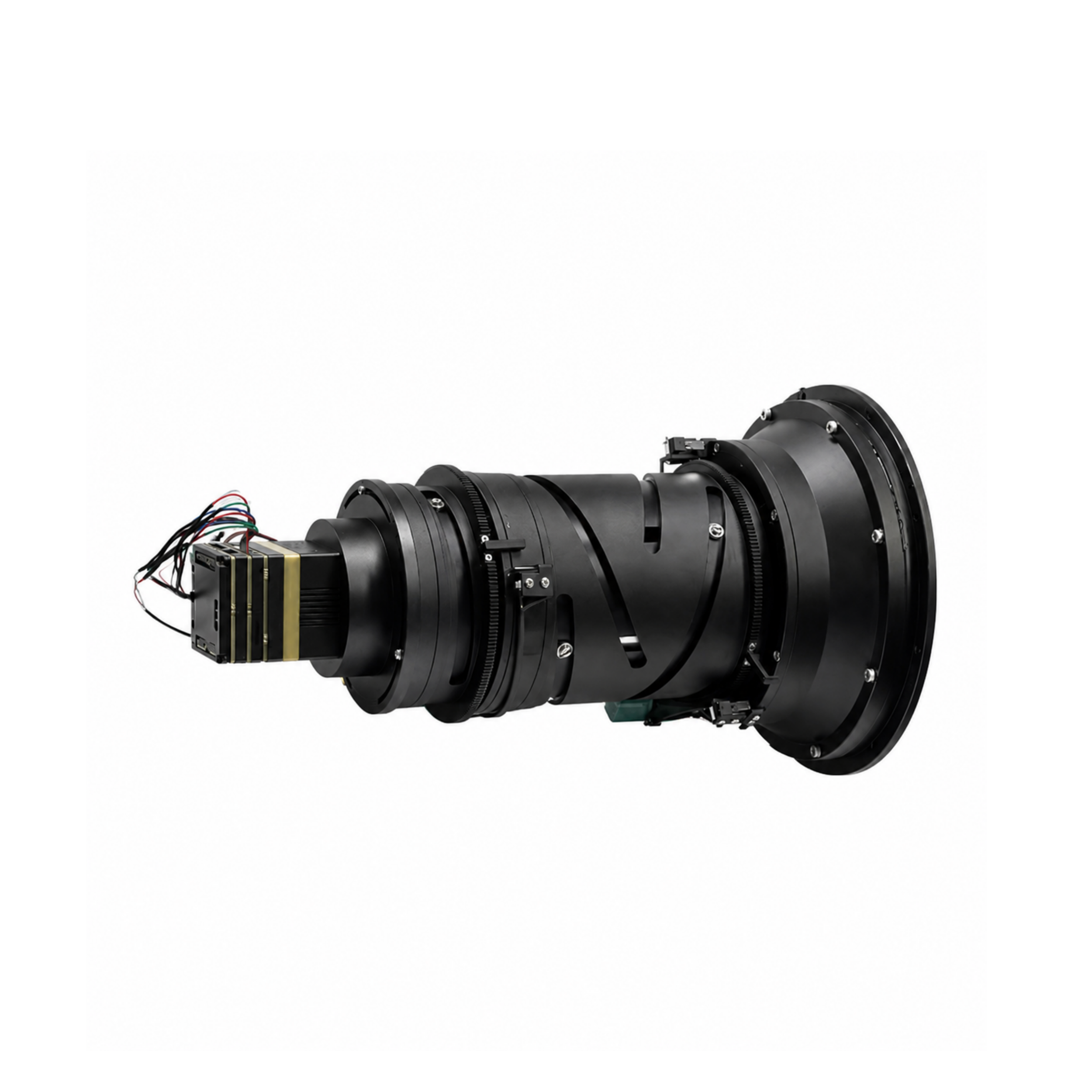
Focal length and Field of View share a strict inverse relationship. As you increase the focal length to capture distant targets, your FOV narrows significantly. You gain extreme range but lose situational awareness. A 200mm lens on a standard sensor provides a horizontal FOV of roughly 2.2 degrees. At one kilometer, your entire viewing window is only 38 meters wide. If an intruder runs at five meters per second, they cross your entire screen in under eight seconds.
Topography directly dictates your lens choice. Vast, flat plains allow for extremely narrow FOVs. You can maximize range without worrying about hidden approaches. Undulating terrain or coastal monitoring requires wider angles. Hills, dips, and coastal curves create natural blind spots. A narrow lens will look right past an intruder hiding in a terrain depression.
Extreme distances create a "soda-straw" viewing effect. Operators lose all perimeter context when staring through a highly magnified, narrow lens. You must mitigate this operational risk. Deploy slew-to-cue systems where ground-based radar or fiber-optic fence sensors direct the camera to the exact coordinates of an intrusion. Alternatively, install secondary wide-angle cameras to maintain broad situational awareness while the narrow lens investigates specific threats.
The F-number defines the size of the lens aperture. It controls the amount of thermal energy reaching the sensor. A lower F-number means a larger aperture. An f/1.0 lens allows significantly more infrared radiation to pass through than an f/1.5 lens. More energy reaching the sensor improves image contrast and clarity.
Long-range lenses force a difficult trade-off. Higher focal lengths typically result in higher F-numbers. Manufacturing an f/1.0 lens at a 150mm focal length requires a massive, heavy, and impractical front germanium element. Most long-range optics settle around f/1.5 or f/2.0 to maintain a manageable physical size and weight.
This higher F-number degrades the Noise Equivalent Temperature Difference (NETD) of the system. NETD measures thermal sensitivity. If a sensor boasts a 30mK NETD at f/1.0, that sensitivity drops to roughly 67mK when paired with an f/1.5 lens. A degraded NETD results in a noisier image during low-contrast conditions, such as heavy fog or uniform temperature environments. You must balance your required range against acceptable thermal sensitivity. Do not over-specify focal length if your environment suffers from frequent low-contrast weather.
Many applications extend beyond basic security. Wildfire detection, flare stack monitoring, and critical substation inspections require measuring temperature at a distance. Radiometric lenses allow the system to assign specific temperature values to individual pixels. This transforms the camera into a long-range diagnostic tool.
You must choose a calibrated range covering the coldest and hottest expected surfaces. Include a wide margin for normal environmental variation. If you monitor a transformer expected to run at 80°C, your calibrated range should extend well past 150°C to capture fault conditions accurately without saturating the sensor. Saturated pixels bloom and destroy the surrounding image data.
Lens materials and specialized coatings impact infrared transmission. Standard glass blocks long-wave infrared radiation. Manufacturers use germanium or chalcogenide glass for thermal optics. Specialized anti-reflective coatings maximize transmission efficiency. High transmission rates ensure radiometric accuracy remains reliable across extreme distances. You must also account for target emissivity. A rusted steel tank emits thermal energy differently than polished aluminum, and your software must compensate for these material differences.
You must choose between fixed focal length and continuous zoom mechanics based on your operational profile. Each design offers distinct advantages and mechanical realities.
Lens Type | Mechanical Design | Primary Advantages | Best Application |
|---|---|---|---|
Athermalized Fixed Lens | Passive bimetallic components adjust focus automatically as housing expands. | High reliability, rugged design, lower weight, zero moving parts to fail. | Static perimeters, predictable monitoring zones, sterile zones. |
Continuous Zoom (CZ) Lens | Motorized internal cams move optical elements to change focal length. | Operational flexibility, maintains target lock while zooming, variable FOV. | Active tracking scenarios, drone payloads, border patrol vehicles. |
Athermalized fixed lenses provide unmatched reliability. They lack moving parts, making them ideal for harsh environments with high dust or vibration. Continuous Zoom (CZ) lenses offer operational flexibility. They allow operators to start with a wide FOV to detect movement, then zoom in seamlessly to identify the threat. However, CZ lenses introduce significant mechanical complexity. The internal cams wear out over time. Sand and grit can destroy the mechanical seals, leading to expensive maintenance cycles.
Pairing custom optics with an OEM Thermal Camera Module requires precise engineering. You cannot simply thread a lens onto a sensor and expect optimal performance. Mechanical mounting tolerances must remain exact. Even a microscopic misalignment degrades image sharpness across the focal plane.
Back focal length adjustments present a major integration risk. The distance between the rear lens element and the microbolometer surface must match the optical design perfectly. This tolerance is often measured in microns. If this distance drifts due to thermal expansion in direct sunlight or vibration from a nearby highway, the image blurs permanently.
Software calibration remains mandatory. The module must undergo Non-Uniformity Correction (NUC) paired with the specific lens. Lenses introduce natural vignetting and distortion. The software must map these optical imperfections and apply corrective algorithms. Skipping this calibration results in severe image artifacts, dark corners, and false temperature readings across the array.
Sensor resolution dictates how many pixels you have available to spread across your Field of View. Standard resolutions include QVGA (320x240), VGA (640x512), and HD (1280x1024). Higher resolutions provide exponentially more data points for long-range target identification.
Specifying a high-resolution sensor often proves more efficient than over-specifying the optics. A 640x512 sensor provides four times the pixel count of a 320x240 sensor. This allows you to use a wider lens while still maintaining enough pixels on target to meet Johnson's Criteria. You gain situational awareness without sacrificing detection range.
When deploying a Long Range Thermal Camera, always evaluate the sensor resolution first. Pushing a low-resolution sensor to extreme distances requires massive, heavy lenses. Upgrading the sensor array to 1280x1024 keeps the physical optics manageable, reduces the payload weight on your mounting infrastructure, and improves overall system reliability.
The atmosphere actively fights thermal imaging at long distances. Absolute humidity acts as a wall against infrared radiation. Water vapor absorbs thermal energy in the Long-Wave Infrared (LWIR) and Mid-Wave Infrared (MWIR) bands. High humidity environments drastically reduce the effective range of any lens.
Weather Condition | Approximate Attenuation (dB/km) | Impact on Long-Range Detection |
|---|---|---|
Clear Day (Low Humidity) | 0.2 to 0.5 dB/km | Maximum theoretical range achievable. |
Light Rain / Mist | 1.5 to 2.0 dB/km | Noticeable contrast drop; range reduced by 30-40%. |
Heavy Fog / Tropical Humidity | 3.0+ dB/km | Severe signal loss; range can drop by over 70%. |
Heavy rain and dense fog scatter infrared radiation. While thermal cameras penetrate light fog better than visual cameras, dense moisture still degrades the image. The thermal contrast between the target and the background drops significantly during heavy precipitation. A human body blends into the wet, cold background.
You must calculate weather margins into your initial lens specification. If you need reliable detection at two kilometers, do not specify a lens that maxes out at two kilometers under ideal laboratory conditions. You must specify a lens capable of three or four kilometers to ensure reliable performance during worst-case environmental conditions.
Size, Weight, and Power (SWaP) limitations dictate physical deployment realities. Mobile platforms, drone-mounted systems, and rapid-deployment masts cannot support massive optical payloads. Large germanium lenses weigh several kilograms. They require heavy-duty motors to drive zoom and focus mechanisms, increasing power draw.
Mechanical risks multiply at narrow FOVs. Wind load and structural vibration degrade image quality exponentially. A tiny vibration at the mounting pole translates into massive image shaking when viewing a target three kilometers away. Heavy lenses act like sails in high winds, exacerbating this problem. If mounted on a standard 30-foot fiberglass pole, the wind causes a two-degree sway. With a 2.2-degree FOV, your target swings completely out of the frame.
You must implement strict mitigation strategies. Deploy heavy-duty Pan-Tilt Units (PTU) rated for the specific payload weight. Utilize Electronic Image Stabilization (EIS) algorithms to smooth out high-frequency vibrations, though EIS cannot fix severe structural sway. Ensure rigid infrastructure requirements. Mount long-range systems on dedicated Schedule 40 steel pipes with deep concrete footings rather than shared fences or flexible structures.
Optical hardware must integrate seamlessly with your broader digital ecosystem. A pristine thermal image holds no value if it cannot reach the control room efficiently. Deploying a Network Thermal Camera ensures standard IP connectivity and streamlined data routing across your facility.
ONVIF compliance remains critical. Specifically, ONVIF Profile S and Profile T guarantee interoperability with various Video Management Systems (VMS). You avoid vendor lock-in and ensure the camera communicates properly with existing recording servers, alarm panels, and command interfaces.
Bandwidth management requires careful planning for remote sites. High-resolution thermal streams consume significant network resources. A 640x512 thermal stream running at 30 frames per second requires roughly 2 to 4 Mbps of continuous bandwidth. You must configure variable bitrates and optimize compression codecs like H.265 to maintain image quality without overwhelming cellular backhauls or limited fiber connections.
AI-driven video analytics depend entirely on optical clarity. Edge processing algorithms analyze pixel contrast, edge sharpness, and object shape. They classify targets and trigger intrusion alerts based on these visual data points.
Poor lens selection directly causes algorithmic failures. If a cheap lens produces blurry edges due to spherical aberration, the AI cannot differentiate between a human and a deer. This generates constant false alarms. The analytic software can only process the optical data it receives. It cannot magically sharpen a physically out-of-focus image.
You must match lens quality to analytic requirements. High-end edge processing demands sharp, high-contrast images across the entire focal plane. Investing in superior optics ensures your AI analytics function reliably, reducing operator fatigue and improving overall site security.
Calculate your required Instantaneous Field of View (IFOV) based on your smallest expected target size and maximum engagement distance using Johnson's Criteria.
Specify a sensor with a 12µm pixel pitch to minimize the physical size, weight, and wind load of the required germanium lens.
Conduct a site survey to identify terrain masking risks and determine if you need secondary wide-angle cameras to cover blind spots created by narrow FOV lenses.
Request empirical DRI modeling from the manufacturer using NVTherm software before finalizing any optical specifications or issuing purchase orders.
Mandate a live field demonstration under adverse weather conditions to verify the system meets your calculated weather attenuation margins.
A: These stages follow Johnson's Criteria. Detection requires 1.5 pixels on target, meaning you see an object exists. Recognition requires 6 pixels, allowing you to classify the object as a human or vehicle. Identification requires 12 pixels, enabling you to determine specific details like carried tools or distinct features.
A: Vast, flat plains allow for very narrow Fields of View (FOV) to maximize detection range. Complex, undulating topographies or coastal areas require wider FOVs. Narrow lenses create blind spots in uneven terrain, allowing intruders to bypass the camera using natural depressions.
A: Absolute humidity causes atmospheric attenuation. Water vapor actively absorbs infrared energy in the LWIR and MWIR bands. High humidity environments drastically reduce the amount of thermal energy reaching the sensor, cutting the effective detection range significantly compared to dry conditions.
A: Yes, if equipped with a radiometric lens and calibrated software. You must define specific temperature measurement ranges. However, atmospheric distance degrades measurement accuracy. Water vapor and particulates scatter the infrared signal, requiring complex software compensation to maintain accurate readings at long distances.
A: No. Standard optical glass blocks long-wave infrared radiation. Thermal cameras require specialized materials like germanium or chalcogenide glass to transmit thermal energy to the sensor. Attempting to use a standard glass lens will result in a completely blind thermal camera.
A: A lower F-number like f/1.0 is ideal because it gathers more thermal energy, improving contrast. However, large focal length lenses physically require higher F-numbers like f/1.5 or f/2.0 to keep the lens size and weight manageable. You must balance energy gathering with physical SWaP constraints.


